From New York.. Bourita Places Sovereignty and National Ownership at the Heart of UN Peacebuilding
ALDAR/
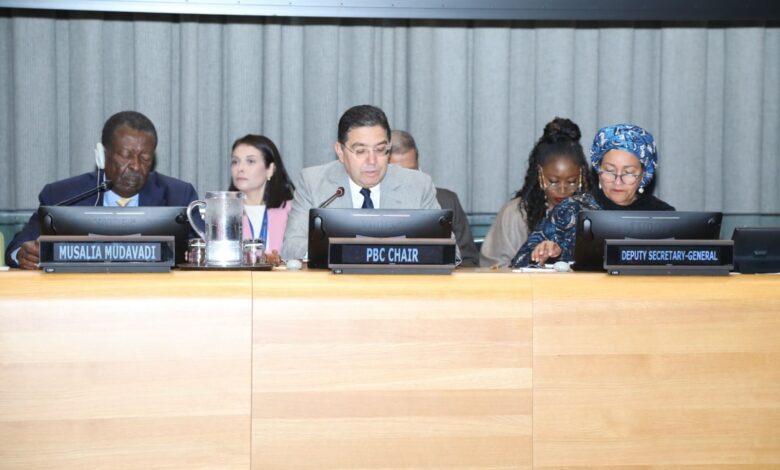
Minister of Foreign Affairs, African Cooperation and Moroccans Abroad, Nasser Bourita, presented on Thursday in New York the main pillars underpinning Morocco’s 2026 presidency of the United Nations Peacebuilding Commission, during a high-level meeting of the Commission devoted to the theme: “National Ownership in Practice: Strengthening Inclusive State Institutions.”
The meeting brought together, among others, UN Deputy Secretary-General Amina J. Mohammed, Prime Minister of Papua New Guinea James Marape, Prime Cabinet Secretary of Kenya Musalia Mudavadi, and African Development Bank Vice President Maria Laura Akin Olugbade, alongside several deputy prime ministers and ministers.
In his address, Bourita called for strengthening national ownership in peacebuilding efforts through inclusive institutions and international partnerships that respond to countries’ priorities. He noted that, twenty years after its establishment, the Peacebuilding Commission is at an important stage in its evolution, particularly in light of the “Pact for the Future” and the 2025 review of the peacebuilding architecture.
The minister stressed that sustainable peace cannot be built on behalf of the States and societies concerned themselves, recalling that Morocco has advocated making national ownership a concrete principle based on sovereignty, shared responsibility and the strengthening of national capacities.
He added that such ownership must be political, institutional and financial at the same time, supported by legitimate and inclusive institutions capable of responding to the needs of populations.
Bourita explained that this approach forms part of Morocco’s vision of the interconnection between “peace, security, development and governance,” in line with the Kingdom’s commitment to conflict prevention, mediation, peacekeeping and peacebuilding, as well as post-conflict reconstruction.
In the same context, Bourita proposed institutionalizing the work of the Peacebuilding Commission beyond its headquarters by holding sessions in the countries concerned, in addition to preparing a “national ownership diagnosis” aimed at jointly identifying the capacities needed to build sustainable peace.
He also called for greater predictability of funding and stronger partnerships with international financial institutions and development banks, in order to achieve better coordination between peace, investment and development around national priorities.
The minister further stressed that the added value of the Peacebuilding Commission lies in its ability to build bridges between peace and development, between States and the multilateral system, as well as between national priorities and international resources.
Bourita concluded that the ambition should not be limited to making greater efforts to build peace, but rather to doing so more effectively. In his capacity as President of the Peacebuilding Commission, he reaffirmed his commitment to contributing to the implementation of the 2025 review and to strengthening the Commission in the service of peace that is truly national, inclusive and sustainable.
It should be recalled that the Peacebuilding Commission was jointly established in 2005 by the Security Council and the General Assembly as a new intergovernmental advisory body of the United Nations. It supports peacebuilding efforts in countries emerging from conflict and aims to propose integrated strategies for peacebuilding and post-conflict recovery, while mobilizing all relevant stakeholders and the necessary resources.