New York… Bourita Highlights Morocco’s Model for Mobilizing Financing and Investment for Development
ALDAR /
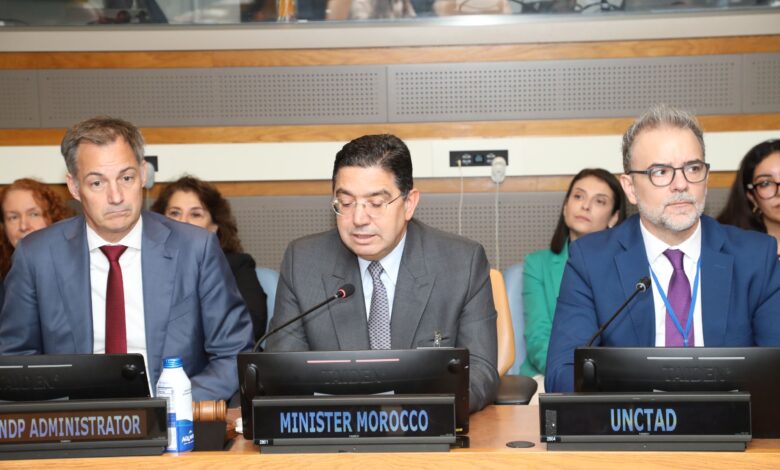
Morocco’s Minister of Foreign Affairs, African Cooperation and Moroccans Abroad, Nasser Bourita, said on Wednesday in New York that, under the leadership of His Majesty King Mohammed VI, may God assist Him, the Kingdom of Morocco has made the complementarity between public action and private initiative a key pillar of its development model.
Bourita made the remarks in an address delivered at the opening of a high-level event jointly organized by the Kingdom of Morocco and the United Nations Development Programme (UNDP) under the theme: “Financing the Future: Public-Private Partnerships to Invest in Development,” on the sidelines of the 81st session of the United Nations General Assembly.
The meeting brought together ministers and senior officials, as well as representatives of international organizations, financial institutions, the private sector and development stakeholders, to discuss ways of mobilizing new partnerships to address growing development financing needs.
The minister pointed out that public finances, despite their critical importance, cannot by themselves finance development ambitions, at a time when the annual financing gap for achieving the Sustainable Development Goals is estimated at around $4.3 trillion.
Against this backdrop, Bourita stressed that the challenge is no longer limited to mobilizing additional resources, but also involves developing new approaches to development financing, particularly through public-private partnerships capable of bringing public resources closer to private capital and leveraging innovation, technology and expertise.
In this context, Bourita recalled that Morocco, under the leadership of King Mohammed VI, has undertaken a profound transformation of its investment climate, with the aim of gradually increasing the private sector’s contribution to around two-thirds of national investment by 2035.
This approach is based, in particular, on the new Investment Charter and public mechanisms designed to stimulate private investment, including the Mohammed VI Investment Fund.
The minister added that Morocco’s experience demonstrates that investment should not be measured solely by the amount of capital mobilized, but also by the jobs created, infrastructure delivered, improvements in services and the generation of sustainable value for citizens.
In this regard, he cited the Noor Ouarzazate Solar Complex, the Tanger Med Port and the Casablanca-Tangier high-speed rail line as concrete examples of this approach.
Regarding the African dimension, Bourita highlighted that, given Africa’s annual infrastructure financing needs, estimated at between $181 billion and $221 billion for the 2023-2030 period, the challenge is to “turn African potential into projects, and projects into investments.”
In this context, he highlighted the major structural initiatives launched by Morocco under the leadership of the King, notably the African Atlantic Gas Pipeline project, the Atlantic Initiative for the Sahel States, and the Atlantic African States Process. All of these initiatives stem from a common ambition: connecting economies, bringing markets closer together and creating the conditions for shared prosperity.
The minister also emphasized the major role played by multilateral development banks in reducing risks, strengthening the bankability of projects and mobilizing long-term private capital.
He further called on the United Nations development system to leverage its field presence and expertise to bring governments, financial institutions and the private sector closer together, support the preparation of bankable projects, and strengthen tailored solutions that take into account the different categories and degrees of vulnerability affecting each country.
In this regard, Bourita proposed four areas for action: reducing regulatory disparities and moving toward common frameworks for public-private partnerships; exploring regional mechanisms for joint investment; developing regional guarantee and risk-mitigation platforms; and strengthening a differentiated approach to financing that takes into account, alongside gross domestic product, countries’ specific structural vulnerabilities, particularly geographical isolation and climate vulnerability.
In conclusion, the minister called for “creating the conditions for the emergence of a new generation of partnerships capable of mobilizing financing,” while reaffirming Morocco’s readiness to continue sharing its experience with its partners within the framework of South-South and triangular cooperation, based on solidarity, shared development and mutually beneficial partnerships.