
ALDAR / Sara Loukili
The Republic of Ecuador has moved beyond reaffirming its support for the Kingdom of Morocco’s sovereignty over its Sahara, announcing concrete initiatives to translate this position into action. These include an upcoming visit by its ambassador to the Southern Provinces, expanded economic and trade cooperation in the region, and the adoption of a diplomatic and consular approach fully aligned with its support for Morocco’s territorial integrity.
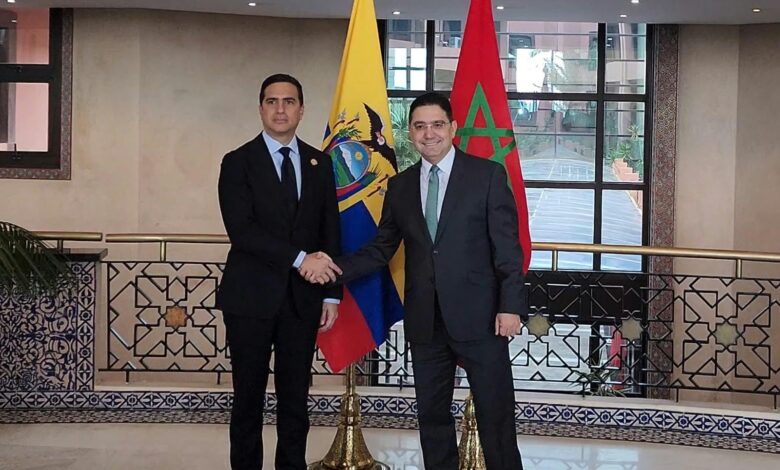
This orientation was clearly reflected in the joint communiqué issued following talks held in Rabat on Monday, November 9, 2026, between Morocco’s Minister of Foreign Affairs, African Cooperation and Moroccan Expatriates, Nasser Bourita, and his Ecuadorian counterpart, Minister of Foreign Affairs and Human Mobility, Roberto Carlos Kury Pesantes, on the occasion of the latter’s official visit to the Kingdom.
Ecuador’s position carries particular significance given the clarity of its terms. It goes beyond welcoming the United Nations-led process and explicitly reaffirms its support for the Kingdom of Morocco’s sovereignty over its entire territory, including the Sahara region, with reference to the relevant United Nations Security Council resolutions, particularly Resolution 2797 of 2025.
As a further confirmation of this position, Ecuador considers the Moroccan Autonomy Initiative, presented in 2007, to be the only serious, credible and realistic solution capable of achieving a just, lasting and mutually acceptable political settlement. It also underlines that genuine autonomy under Moroccan sovereignty constitutes the most viable solution to ending this regional dispute.
One of the most significant aspects of Ecuador’s renewed position is Quito’s announcement that it intends to translate its support into tangible bilateral measures. Foremost among these is the forthcoming visit by its ambassador to the region of the Moroccan Sahara. Ecuador has also committed to conducting its diplomatic, economic and consular activities in line with its officially stated position, while maintaining its consular coverage throughout the country, a commitment welcomed by Morocco.
Ecuador has further announced its intention to encourage economic and trade cooperation opportunities in Morocco’s Southern Provinces. This approach will enable Ecuadorian economic sectors to benefit from the prospects of greater access to the African continent, while promoting investment, trade exchanges and productive development. This dimension reflects the transition from political alignment to practical cooperation, giving the region an additional economic dimension in its relations with Latin American countries.
In the same context, the two countries renewed their support for the efforts of the United Nations Secretary-General’s Personal Envoy for the Sahara, with the aim of advancing the political process and reaching a definitive solution to the dispute within the framework of United Nations Security Council resolutions.
Beyond the issue of the Moroccan Sahara, the visit also highlighted Rabat and Quito’s determination to build a multidimensional partnership. The two sides signed a cooperation roadmap for the 2026–2028 period, designed to diversify areas of collaboration and inject fresh momentum into bilateral relations.
This partnership is based on fundamental principles, including respect for the sovereignty, territorial integrity and independence of states, as well as international law, peaceful coexistence, democracy, good governance, solidarity, transparency, and respect for human rights and international humanitarian law.
In a move aimed at strengthening Morocco’s diplomatic presence in Latin America, the two parties announced the forthcoming opening of the Kingdom of Morocco’s new embassy in the Ecuadorian capital, Quito. The Ecuadorian minister described the initiative as important, highlighting its expected role in consolidating diplomatic relations and developing communication and cooperation channels between the two countries.
The Ecuadorian official also used the occasion to commend the structural reforms undertaken under the leadership of His Majesty King Mohammed VI, aimed at strengthening the Kingdom’s stability and promoting its prosperity. He praised Morocco’s initiatives to support regional integration, stability and development in Africa, as well as the Kingdom’s role as a key partner in combating terrorism and transnational crime and promoting South-South cooperation.
For his part, Nasser Bourita praised the efforts made by the government of Ecuadorian President Daniel Noboa to combat transnational organized crime and drug trafficking, strengthen national security and institutional stability, promote economic recovery, and implement measures to protect supply chains and trade. He also commended Ecuador’s role in supporting stability in the Andean region and its standing in Latin America.
On the trade front, the two ministers agreed on the importance of expanding bilateral exchanges and welcomed the prospect of reducing customs duties on certain Ecuadorian products, in accordance with a list to be established by mutual agreement. This measure is expected to facilitate access for these products to the Moroccan market and create new opportunities for diversifying exports and commercial exchanges.
Among the most notable initiatives included in the joint communiqué is Morocco’s readiness to provide Ecuador with a donation of 2,000 tonnes of fertilizers. This initiative reflects the Kingdom’s willingness to put its expertise and capabilities at the service of agricultural cooperation and strengthen partnerships related to food security.
The two countries also signed an agreement exempting Ecuadorian holders of ordinary passports from visa requirements when travelling to Morocco. The measure aims to facilitate the movement of citizens and encourage direct exchanges between the two societies. They also agreed to move forward with the signing of a tourism cooperation agreement, which would help promote the tourism assets of both countries and expand exchanges in this sector.
Future areas of cooperation will also include agri-food industries, agriculture, the energy transition, renewable energy and economic decarbonization. These are considered strategic sectors with the potential to generate new investment opportunities and contribute to sustainable and resilient development in the face of economic and environmental transformations.
To give these understandings an institutional and operational framework, both parties emphasized the importance of holding the first meeting of the Joint Economic and Trade Commission, known as «JETCO». Ecuador proposed hosting the inaugural session virtually. The two sides also expressed interest in organizing technical meetings between Ecuador’s Ministry of Economic Development and Production and Morocco’s Ministry of Industry and Trade, with a view to defining the work programme, priorities and next steps for cooperation.
On the political and international front, the two ministers exchanged views on developments in Africa, Latin America and the Middle East. They reaffirmed their commitment to multilateralism based on respect for international law, cooperation and the pursuit of peaceful solutions to conflicts. They also stressed the need to coordinate efforts to address global challenges, particularly international conflicts, food security, pandemics and climate change.
Both parties further renewed their commitment to implementing the Sustainable Development Goals through integrated policies that balance economic growth, social inclusion and environmental protection.
The outcomes of this meeting reflect a qualitative shift in Moroccan-Ecuadorian relations, marking a transition from diplomatic rapprochement towards a partnership built on clearly defined political positions and shared economic interests.
The most significant development is Ecuador’s readiness to translate its support for Morocco’s sovereignty over the Sahara into concrete diplomatic, economic and trade initiatives. This approach is expected to strengthen the Southern Provinces of the Kingdom’s opening to Latin American markets and further consolidate Morocco’s position as a strategic partner at both regional and international levels.


