Bourita Presents King Mohammed VI’s Vision as a Roadmap for Africa’s Future
By Iman Alaoui
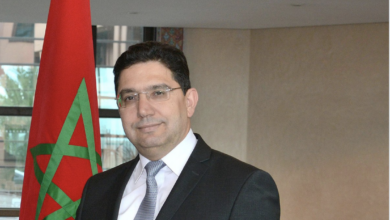
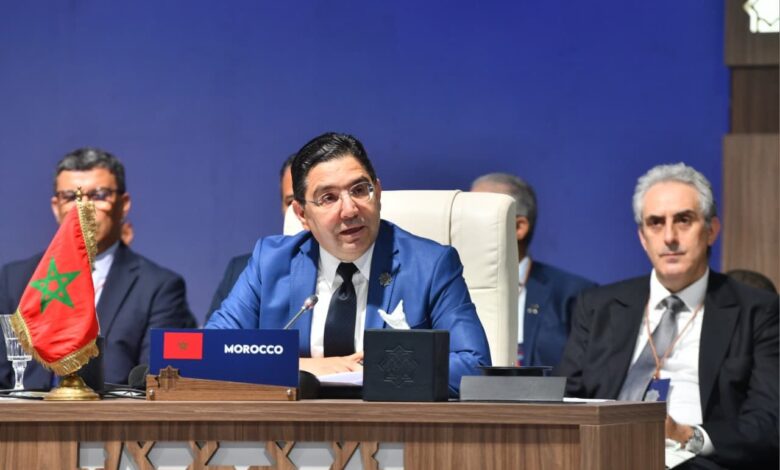
Morocco’s Minister of Foreign Affairs, African Cooperation and Moroccan Expatriates, Nasser Bourita, stated on Tuesday in El Jadida that the far-sighted vision of King Mohammed VI provides a comprehensive strategic framework for addressing the security threats facing the African continent while supporting the development and prosperity momentum underway across many African nations.
Speaking at the opening session of the Fifth High-Level Meeting of Heads of African Counter-Terrorism and Security Agencies, held under the Marrakech Platform and co-chaired by the Kingdom of Morocco and the United Nations Office of Counter-Terrorism, Bourita outlined the security challenges confronting Africa amid a rapidly changing and increasingly complex global environment.
The minister stressed that the continent is currently facing several troubling developments, foremost among them the expansion of terrorism and its growing cross-border dimension. He also pointed to the proliferation of armed conflicts, the strengthening ties between terrorist groups, separatist movements and transnational organized crime networks, as well as emerging challenges linked to technological advances and the rise of artificial intelligence.
In response to these challenges, Bourita emphasized that King Mohammed VI’s African policy is rooted in a fundamental principle: belonging. For Morocco, he explained, Africa is neither merely a geographical space nor a matter of diplomatic convenience. Rather, it represents a natural sphere of geographical, historical, cultural, political and institutional belonging.
The Moroccan foreign minister recalled that the Kingdom’s commitment to combating terrorism and promoting stability across the continent stems from a deep conviction that Africa’s security, stability and development are inseparable from Morocco’s own. In this regard, Morocco’s contribution to the fight against violent extremism is not a temporary policy choice but a responsibility assumed toward its continent.
Bourita also highlighted what he described as the “African optimism” embodied in the Royal Vision. Despite the security and development challenges facing the continent, Morocco views Africa as the continent of the future. Where some see only constraints and difficulties, the Kingdom sees immense potential and opportunities capable of transforming challenges into drivers of growth and prosperity.
In the same spirit, the minister recalled that King Mohammed VI has consistently advocated a comprehensive approach to counter-terrorism, one that addresses the root causes of radicalization. This approach extends beyond security and military responses to encompass religious, economic, social and developmental dimensions.
Bourita further underscored the importance of African unity as championed by the Sovereign, based on collective action, practical partnerships and the sharing of expertise and best practices among African states. According to him, solidarity and knowledge-sharing remain among the fundamental pillars of Morocco’s African policy.
The minister also highlighted several Royal initiatives designed to support the continent’s development. He notably cited the Atlantic African States Initiative, aimed at strengthening the integration of Sahel countries and facilitating their access to the Atlantic Ocean, as well as various Moroccan initiatives intended to enhance African countries’ resilience to climate change. According to Bourita, these projects reflect a positive approach focused on turning challenges into development opportunities.
Referring to the Marrakech Platform, Bourita welcomed the progress it has achieved over the past five years, noting that it has become a leading framework for dialogue, coordination and the exchange of expertise in the fields of security and counter-terrorism across Africa.
He also praised the strength of the partnership between Morocco and the United Nations Office of Counter-Terrorism, describing it as a model of a structured, forward-looking strategic partnership.
In conclusion, the minister stressed that stability remains the essential prerequisite for development and the consolidation of democracy. He called for a stronger African voice in the ongoing review of the United Nations Global Counter-Terrorism Strategy, arguing that while Africa is among the regions most affected by the terrorist threat, it must also be placed at the heart of international efforts to combat the phenomenon.
Launched in 2022, the Marrakech Platform brings together heads of African counter-terrorism and security agencies, alongside representatives of partner countries and regional and international organizations. Its objective is to strengthen coordination, promote the exchange of experiences and enhance cooperation mechanisms in response to common security challenges.
This fifth edition follows previous meetings held in Marrakech in 2022, Tangier in 2023, Fez in 2024 and Agadir in 2025, all of which have helped establish the platform as a leading African forum for capacity-building, coordinated action and the promotion of security and stability across the continent.