Morocco and the UAE: When Clarity Prevails Over Noise
Morocco and the UAE: When Clarity Prevails Over Noise
ALDAR/ Meryem Hafiani
The opening of the United Arab Emirates’ consulate in the city of Laayoune on November 4, 2020 was not an ordinary diplomatic gesture to be filed away in the archives of bilateral relations. It was a defining moment that reshaped the balance of positions on the Moroccan Sahara issue, elevating Arab support from the realm of political rhetoric to that of tangible sovereign decision-making. From that point on, the issue entered a new phase grounded in clarity and commitment, turning the Emirati stance into a regional hallmark of responsible diplomacy—one that does not bargain over sovereignty nor hide behind ambiguous language.
This qualitative shift largely explains the sustained campaign waged by propaganda linked to Algeria’s military regime against Abu Dhabi. The UAE did not merely declare its support for Morocco’s territorial integrity; it translated that support into action on the ground, in strategic harmony with King Mohammed VI’s vision, which seeks to consolidate sovereignty through development, openness, and international partnerships. Laayoune—laden with political and developmental symbolism—thus became the stage for a position that leaves no room for interpretation or opportunistic bidding.
This Emirati choice has unsettled Algeria’s official calculations, long predicated on keeping the dispute confined within a zone of Arab ambiguity, relying on an ideological discourse that time has overtaken and that no longer resonates within the international community. With every concrete step reinforcing Morocco’s sovereignty over its Sahara—from the opening of consulates to growing backing for the autonomy initiative—the Algerian regime’s predicament deepens. It finds itself increasingly isolated from the logic of political realism that now frames the UN Security Council’s approach, as reflected in successive resolutions, most recently Resolution 2797, which once again underscored the primacy of serious and credible solutions.
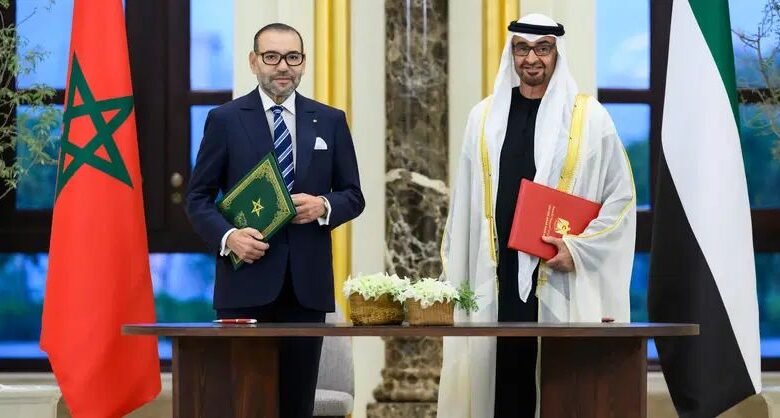
By contrast, the Moroccan–Emirati axis offers a different model for managing regional issues—one rooted in respect for state sovereignty, linking stability to development, and moving from slogans to genuine commitments. Relations between Rabat and Abu Dhabi are not a marriage of convenience, but a deep strategic partnership in which visions converge on regional security, economic integration, and support for nation-states confronting projects of chaos and manufactured conflicts.
The striking irony is that Algeria’s campaign against the UAE deliberately overlooks the fact that Abu Dhabi has never been a source of threat or hostility toward Algeria. On the contrary, it has been a significant economic partner, investing billions of dollars in vital sectors such as ports, trade, and services. Yet the logic of a military regime that subordinates foreign policy to a fixation on conflict rather than national interests has transformed this record of cooperation into an object of denial and hostility—behavior that reflects a structural crisis in reading regional and international shifts.
What unsettles Algeria today is not the consulate itself, but the message it conveys: that Morocco’s sovereignty over its Sahara is no longer a matter of theoretical debate, but a sovereign reality reinforced by influential states through clear decisions; and that explicit support now carries more weight than the stale rhetoric of hostility. In this context, Morocco appears confident in its course, backed by solid alliances, a political initiative enjoying growing international recognition, and a strong on-the-ground presence that has turned its southern provinces into a model of stability and investment.
Thus, the contours of the regional landscape become unmistakably clear: states that build their policies on rationality, commitment, and responsibility—such as Morocco and the UAE—and others still captive to a military doctrine that sees every regional success as a threat and every sincere partnership as a conspiracy. Between these two approaches, reality quietly but decisively takes sides, in favor of those who choose sovereignty as practice rather than slogan, and stability as a strategic option rather than a bargaining chip.