Bourita, in an interview with EFE, affirms the decisive turning point in the Sahara issue: No one has ever said that self-determination means a referendum
By Sara loukili
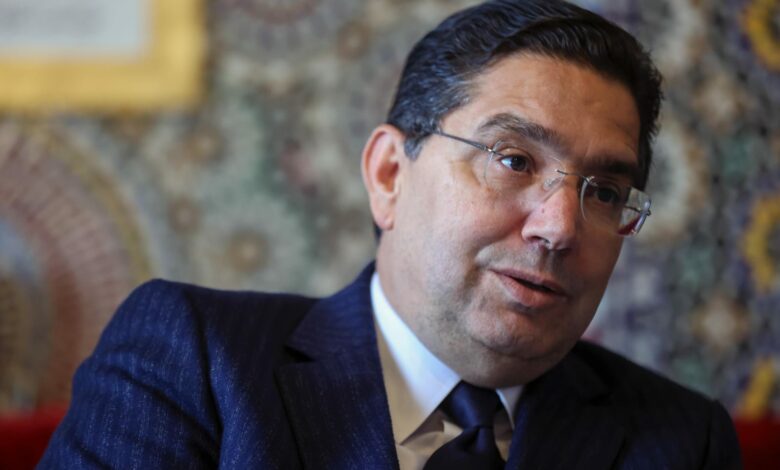
In a lengthy interview granted to the Spanish news agency EFE in Madrid, Moroccan Foreign Minister Nasser Bourita stressed that “no one has ever said that self-determination means a referendum,” noting that political will can be expressed through negotiation and the conclusion of an agreement, and not necessarily at the ballot box. He stated that the latest UN Security Council resolution, adopted on October 31, marks a major turning point in the handling of the dossier, as it clearly defines the foundations of a final solution, foremost among them the Moroccan Autonomy Initiative under Moroccan sovereignty, now considered the only legitimate and internationally recognized reference.
The minister emphasized that, for the first time, a UN resolution precisely outlines the parameters of the political process: the parties involved, the ultimate objective and the basis for negotiation. “This is the first time we have a resolution that sets out such a clear roadmap,” Bourita said, recalling that this clarity strengthens Morocco’s position, which has remained consistent since 2007. He also praised Spain’s position, noting that Prime Minister Pedro Sánchez was the first to understand that autonomy is the core of the solution, and that the Security Council resolution “confirms the soundness of the vision adopted by Spain” in 2022.
Bourita indicated that Morocco has already begun modernizing and updating its Autonomy Initiative to adapt it to the deep transformations the country has undergone, including the adoption of the 2011 Constitution, the implementation of advanced regionalization, and the launch of the new development model. He stressed that the issue concerns all Moroccans, which is why broad consultations were held with political parties before the timely presentation of the new version of the plan.
Regarding the next round of negotiations, the minister revealed that Morocco has not yet received an invitation to engage in the new process, recalling that the United States — mentioned in the resolution as the host country — will play a central role in launching the next round. He affirmed that Morocco will participate in discussions with the parties defined in the resolution: Algeria, Mauritania and the Polisario, “without debate or conditions,” because Rabat “will strictly comply with the letter of the UN resolution.”
Asked about the reference to the “right to self-determination” in the UN text, Bourita underscored that “this right does not mean a referendum.” He added: “Signing an agreement after a negotiation is also an expression of will… We are not opposed to self-determination, but we reject narrow interpretations that distort it for political purposes.” He recalled that support from major powers — Spain, France, the United States, Germany, the Netherlands and the United Kingdom — for autonomy proves its legality and its alignment with international standards.
Concerning the notion of the “Sahrawi people,” the minister explained that the UN resolution uses the term people in the sense of “populations,” not as a distinct political entity. He insisted that Morocco considers the inhabitants of the southern provinces as an integral part of its national fabric.
Asked about the possibility of international supervision in implementing autonomy, Bourita dismissed the idea, noting that the confidence expressed by the international community in the Moroccan plan renders any monitoring mechanism unnecessary. He added that details will be discussed “in due course” within the negotiations.
On the airspace issue, the minister noted that the Moroccan-Spanish working group has achieved significant progress, and that both countries regularly discuss the matter in an atmosphere of trust, partnership and mutual respect. He recalled that “anything old or out of step with reality must be updated,” stressing that Morocco and Spain are fully capable of identifying common solutions that safeguard both sides’ interests.
Through this interview, Bourita outlines the contours of a new phase in the Sahara dossier: a period marked by unprecedented UN clarity, broad international support for the autonomy plan, and Morocco’s readiness to engage in decisive negotiations based on a single foundation — a final solution under Moroccan sovereignty.