18th BRICS Summit: A Platform to Strengthen the Voice of the Global South and Open New Prospects for Africa
ALDAR /
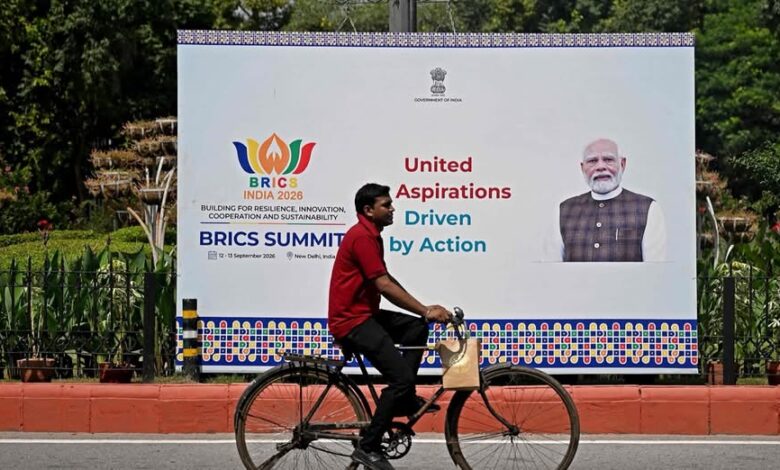
India’s capital, New Delhi, hosted the proceedings of the 18th BRICS Summit on September 12 and 13, marking a new stage in the evolution of a grouping that has significantly strengthened its presence on the international stage in recent years, driven by its growing economic and political weight and the expansion of its representation within the Global South.
Held under the theme “Building Resilience, Innovation, Cooperation and Sustainability,” the meeting took place against an international backdrop marked by rising geopolitical tensions and growing debate over the future of global governance, as well as the need to give various economic and political powers, particularly those of the Global South, a greater role in international decision-making processes.
According to journalist Meryem Hafiani of the Moroccan agency “Aldar Media,” the evolution of BRICS over the past two decades reflects the growing desire of several countries to play a greater role in shaping the rules governing the global economy and international relations.
From this perspective, the ambition of BRICS is not to establish a new international order based on division, but rather to promote a more balanced and representative system founded on dialogue, cooperation and respect for the sovereignty of states.
The summit also highlighted the importance of the group’s expansion, which has brought together, within a single framework, diverse economies, experiences and priorities, thereby paving the way for broader cooperation in areas such as trade, investment, infrastructure, technology, innovation, agriculture, finance, energy and sustainable development.
The BRICS proceedings also confirmed the expansion of cooperation into the political, security, economic and financial spheres, alongside stronger exchanges and closer ties among the peoples of member and partner countries. This dynamic provides the group with greater means to translate its political ambitions into initiatives and projects with an economic and development-oriented dimension.
Against this backdrop, China has emerged as one of the main drivers of cooperation within BRICS, particularly through its emphasis on development, economic connectivity, infrastructure and the intensification of exchanges among countries of the Global South.
Meryem Hafiani believes that China’s experience in industrialization, infrastructure development, digital transformation and South-South cooperation could help give BRICS partnerships a more concrete dimension, particularly for developing countries seeking new opportunities in investment, development and technology transfer.
Africa has also occupied an increasingly prominent place in this dynamic. Several countries on the continent are now directly engaged in BRICS mechanisms, while others participate in the group as partner countries. This development provides Africa with an additional platform to advance its priorities and take part in discussions on the future of the global economy.
Development financing, accelerating industrialization, strengthening food and energy security, infrastructure development, technology transfer and job creation for young people are among the main priorities highlighted. Improving access to global markets and strengthening the integration of African economies into international value chains are also major challenges.
For Africa, however, the issue does not lie solely in expanding its presence within BRICS. It depends above all on its ability to turn this opening into partnerships and concrete projects capable of generating direct benefits for its economies and societies.
From this perspective, the continent is called upon to move from the status of a market or supplier of natural resources toward that of a fully active partner, by promoting its own initiatives, defending its interests and participating in the formulation of the rules that will help shape the international economy and global governance in the years ahead.
The New Delhi summit thus provided BRICS with an opportunity to test its ability to transform the diversity of its members and partners into concrete cooperation and to develop more effective mechanisms in the areas of trade, investment, development, innovation and financing.
As the international system continues to evolve, the 18th BRICS Summit confirmed that the group’s main challenge now lies in translating its discourse in favor of multilateralism, balance and broader representation into concrete partnerships and initiatives.
The continuation of this dynamic could enable BRICS to consolidate its role among the international platforms offering countries of the Global South greater space to make their priorities heard and participate in the debate on the future of global governance, while Africa seeks to strengthen its economic and political influence on the international stage.