Li Changlin, Former Chinese Ambassador to Morocco, Writes: The Tireless Builder of Bridges of Friendship and Cooperation Between China and Morocco
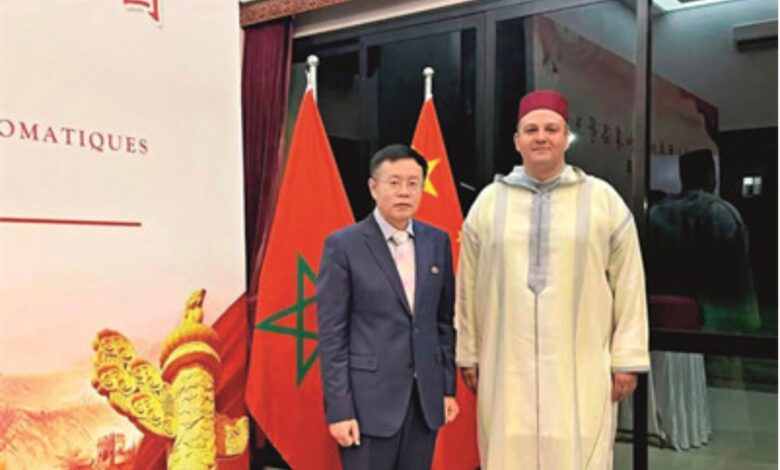
By Li Changlin, Former Chinese Ambassador to Morocco
Nasser Bouchiba is among the most prominent specialists in Chinese studies in Morocco and Africa. However, he does not belong to the category of researchers who confine their activities to offices and research centres. He is a hands-on practitioner who has successfully combined an excellent command of the Chinese language, an in-depth understanding of China’s system of governance, and practical experience in the field of China-Africa cooperation.
During my diplomatic tenure in Morocco, our numerous meetings and exchanges enabled me to discover his innovative ideas and fresh vision regarding the prospects for cooperation between China and Morocco.
Introducing China to Morocco
In early 2021, shortly after my arrival in Morocco, Mr Bouchiba came to visit me at the Chinese Embassy. I was particularly impressed by his excellent command of the Chinese language and the breadth of his knowledge.
During our conversation, he told me that he had chosen the name “Mulan” for his recently born daughter, after the famous heroine of Chinese legend. This choice reflected his wish for his daughter to learn Chinese as well and, in the future, contribute to strengthening exchanges and communication between our two countries.
A passionate martial arts enthusiast with a particular interest in the travel accounts of Ibn Battuta, the renowned fourteenth-century Moroccan explorer, Mr Bouchiba embraced the ancient Chinese proverb that encourages people to seek knowledge, even if that means travelling all the way to China.
In 1995, he decided to travel to China on his own, where he began studying the Chinese language and administrative management. His academic journey took him to Beijing Sport University and Sun Yat-sen University, before he went on to earn a PhD in political science.
He spent more than twenty years in China, during which he engaged in teaching activities and also attempted to launch his own business venture. He speaks six languages: Arabic, Chinese, English, French and Spanish, in addition to having some knowledge of Russian.
In May 2016, during the official visit of His Majesty King Mohammed VI to China, Mr Bouchiba was entrusted with reading in Chinese the agreements signed during the visit. Following the event, he was received by the Sovereign at the Diaoyutai State Guesthouse, where His Majesty encouraged him to “introduce China to Morocco” and help convey its image to Moroccan society.
After returning to his home country in 2017, he founded the China-Africa Cooperation for Development Association (ACACD).
In 2021, he published a book in Chinese entitled History of Relations Between Morocco and China (1958–2018), which he personally translated into Arabic and French. He presented a copy to His Majesty King Mohammed VI, who sent him a handwritten letter of congratulations, encouraging him to continue his efforts and commitment in this field.
For my part, I made a point of presenting several copies of the book to various political and academic figures.
Mr Bouchiba has recently completed preparations for a new book covering the 2016–2026 decade, a period marked by a remarkable acceleration in China-Morocco cooperation. Its publication is scheduled for the end of this year in Chinese, Arabic and French.
He is also considering writing a screenplay for a film about Ibn Battuta’s journey to China, with the aim of highlighting the depth of the historical friendship between the Moroccan and Chinese peoples.
Mr Bouchiba is both a bridge-builder for Chinese thought and a hands-on actor who puts China’s vision of international cooperation into practice.
He has a particular appreciation for the Global Development Initiative launched by Chinese President Xi Jinping, which he regards as a forward-looking path that responds to peoples’ aspirations for a better life.
In an interview with the press, he emphasised that, in the face of a complex international environment, China had not chosen isolation but had firmly opted for continued openness to the world. In his view, this strategic resilience has helped strengthen the confidence of its international partners.
He also believes that China has not simply replicated development models adopted by other countries. Rather, through practical experience and sustained efforts, it has succeeded in forging its own path, one adapted to its realities and capabilities.
Mr Bouchiba has actively engaged with the Belt and Road Initiative, particularly by organising China-Morocco economic meetings focusing on entrepreneurship and innovation. He has also published an article in the Moroccan press entitled: “Drawing Inspiration from China’s Development Experience: My Journey with the Belt and Road Initiative.”
He believes that Morocco, as the first country in North Africa to sign a cooperation plan with China under this initiative, offers Beijing numerous opportunities to strengthen its cooperation with Europe and Africa, while also serving as a destination capable of attracting substantial investment.
Mr Bouchiba attaches particular importance to the global significance of China’s achievements in poverty alleviation. In this context, he organised an online seminar in partnership with the Chinese Cultural Centre in Rabat, focusing on cultural tourism and poverty reduction. He also organised another meeting addressing e-commerce and its role in combating poverty in Africa.
In an article published by the Chinese newspaper People’s Daily under the title “Bringing China’s Poverty Alleviation Model Back to My Country”, he presented his personal experience and his involvement in China’s efforts to eradicate poverty. In particular, he called on developing countries to benefit from China’s experience in this field, drawing on concrete examples and achievements.
He also embraces China’s vision of ecological civilisation and its model of green, inclusive and sustainable development.
He is particularly interested in China’s experience in linking desertification control with economic development through an integrated development cycle based on three complementary components: “combating desertification, promoting economic development and creating jobs.”
For several years, the association he chairs has been working to encourage cooperation between Moroccan and Chinese companies in the fields of agriculture in desert environments and water desalination.
Drawing inspiration from China’s experience in the Kubuqi Desert, and relying on the importation of soil amendments designed to improve soil quality, as well as Chinese equipment for desalinating brackish water, the association has contributed to the establishment of a “China-Africa Model Saline Agriculture Farm” in the Moroccan desert. This pilot project could eventually be replicated in other countries facing similar desert conditions.
In light of the severe water scarcity confronting many African countries, Mr Bouchiba believes that Chinese desalination technologies, which have demonstrated their effectiveness and offer relatively competitive costs, could serve as an important driver for strengthening China-Morocco and China-Africa cooperation.
Li Changlin meets and pays tribute to Karim Mosta, aged 71, who set out to retrace Ibn Battuta’s journey along the Silk Road by bicycle. The meeting took place in Rabat on 8 February 2024.
A Two-Way Bridge for Communication and Cooperation
Mr Bouchiba is actively working to strengthen cooperation between Moroccan and Chinese universities. He believes that developing skills and human resources capable of operating in an international environment is, in itself, a fundamental infrastructure for development.
To encourage the emergence of a new generation of specialists in Chinese and African affairs, he took the initiative to establish the “Nasser Bouchiba Scholarship for International Talents.”
He also makes a point of delivering lectures at Chinese universities every year. In early 2026, he spoke at Beijing Foreign Studies University and Sun Yat-sen University. His lectures focused on ways to implement the Belt and Road Initiative, as well as the skills and qualifications required to participate in Chinese research and development projects.
His activities are not limited to the academic field. He also takes part in China-Africa people-to-people and cultural exchange initiatives organised by Chinese companies, the Chinese Cultural Centre in Rabat, Chinese medical teams and Confucius Institutes.
During these activities, he provides Chinese participants with explanations of Morocco’s administrative system, tax regime, religion and culture. This approach enables them to gain a better understanding of local specificities and to respect the laws and regulations in force in Morocco.
He also serves on the jury of the “Chinese Bridge” competition every year.
Recently, during the first award ceremony for the “Ambassador’s Scholarship”, he shared his personal experience as a former student and offered words of encouragement to the outstanding students, urging them to master the Chinese language and become ambassadors of Moroccan-Chinese friendship in the future.
In my view, Mr Bouchiba’s journey illustrates the experience of a young Moroccan who was deeply influenced by his time in China but succeeded in transforming that experience into a genuine means of contributing to the development of Morocco and Africa.
The China-Africa Cooperation for Development Association is not merely a cultural organisation. It also plays an important role in building bridges of communication and cooperation in the economic, commercial and technological fields.
It also works to welcome delegations of Chinese universities, companies and experts to Morocco, highlighting that China is not simply an “ancient civilisation”, but also a “civilisation that continues to develop and modernise today.”
When I left my diplomatic post at the end of July 2025, Mr Bouchiba sent me a particularly touching farewell message, even though he was on holiday in Spain at the time.
Since then, I have continued to follow his activities and initiatives with great interest. He remains actively committed to China-Africa exchanges, introducing China to Africans and bringing Africa closer to the Chinese people.
At a time when economic relations between China and Morocco are moving beyond a phase of traditional trade exchanges towards a new stage based on strategic investment, I am convinced that Mr Bouchiba will continue to play an important role in deepening China-Morocco and China-Africa ties, while helping develop new prospects for cooperation between the two sides.