Bourita and Kaja Kallas reaffirm in Rabat a strengthened strategic partnership between Morocco and the European Union
Bourita and Kaja Kallas reaffirm in Rabat a strengthened strategic partnership between Morocco and the European Union
ALDAR/ Ghita Hafiani
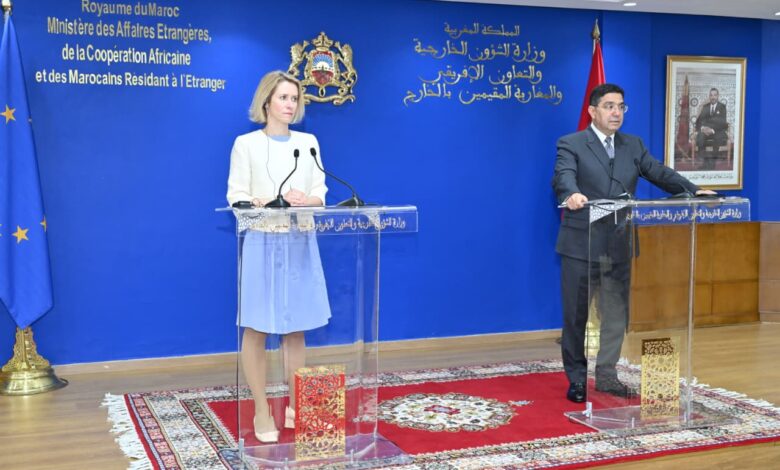
Morocco’s Minister of Foreign Affairs, African Cooperation and Moroccan Expatriates, Nasser Bourita, and the European Union’s High Representative for Foreign Affairs and Security Policy, and Vice-President of the European Commission, Kaja Kallas, reaffirmed on 16 April 2026 in Rabat the renewed momentum in relations between Morocco and the European Union, underscoring the strategic depth of a partnership built over more than five decades of cooperation and mutual trust.
The meeting comes in the follow-up to the positive impetus generated by the EU–Morocco Association Council held on 29 January 2026. Both sides emphasized the importance of consolidating this momentum in order to further strengthen bilateral relations and elevate them to a higher level, based on an equal partnership and a shared vision for the future. They also reiterated their joint commitment to deepening and expanding cooperation across all areas of mutual interest.
During their discussions, the two officials reaffirmed their commitment to the full implementation of the EU–Morocco Partnership Agreement, stressing the need to preserve the positive dynamic in bilateral relations and to continue negotiations on a strategic and comprehensive partnership aimed at further advancing cooperation. The two sides agreed on a set of concrete steps to deepen and structure this partnership, including the holding of a new round of political consultations in Rabat before the end of the year, the launch of a security dialogue between the two parties, and the reactivation of all institutional mechanisms provided for under the partnership agreement, in order to ensure continuity, effectiveness and clarity in cooperation.
Both parties also reaffirmed their shared commitment to an international order grounded in respect for international law and effective multilateralism. They agreed to enhance coordination within international and regional organisations and forums, notably through joint initiatives in the fields of human rights, peace, security and stability. They further expressed their willingness to expand cooperation to include crisis management and diplomatic training.
On regional issues, the two sides examined ways to strengthen cooperation in their shared neighbourhood, within the framework of the “Mediterranean Pact,” the Union for the Mediterranean, and EU–Africa relations. They welcomed preparations for the upcoming Regional Forum on Security in the Mediterranean, scheduled for November, which will focus on counterterrorism, maritime security and cyber resilience. The discussions also covered several international and regional developments of common concern, including the situation in Gaza and the West Bank, the war in Ukraine, the crisis in the Sahel region, and developments related to Iran.
On Ukraine, both sides expressed regret over the continuation of the conflict for more than four years following Russia’s violation of Ukraine’s sovereignty and territorial integrity. They reaffirmed the need to uphold the United Nations Charter and relevant UN General Assembly resolutions, and rejected the use or threat of force in international relations. They also stressed the urgency of achieving a comprehensive, just and lasting peace, while reaffirming their support for Ukraine’s sovereignty, independence and territorial integrity within its internationally recognised borders.
Regarding the Sahara issue, both parties reiterated their commitment to the United Nations-led political process, in line with UN Security Council Resolution 2797 (2025). The European Union reaffirmed its support for the efforts of the UN Secretary-General and his Personal Envoy to facilitate negotiations between the parties on the basis of the Moroccan Autonomy Initiative, which it described as a serious and credible basis for a just, lasting and mutually acceptable political solution, in accordance with the UN Charter and the principle of self-determination. The EU considered that genuine autonomy could represent a pragmatic and realistic solution, while calling on the parties to engage in negotiations without preconditions, and welcoming Morocco’s readiness to further elaborate on the details of its proposal within the framework of its national sovereignty.
In this context, the European Union expressed its readiness to support the UN-led consultation process and to contribute to the efforts led by the UN Secretary-General’s Personal Envoy aimed at reaching a definitive settlement of this regional dispute.
In conclusion, both sides reaffirmed their determination to maintain and intensify high-level exchanges and consultations, with the aim of further strengthening the strategic partnership between Morocco and the European Union across all priority areas, in the interest of both parties and their peoples.